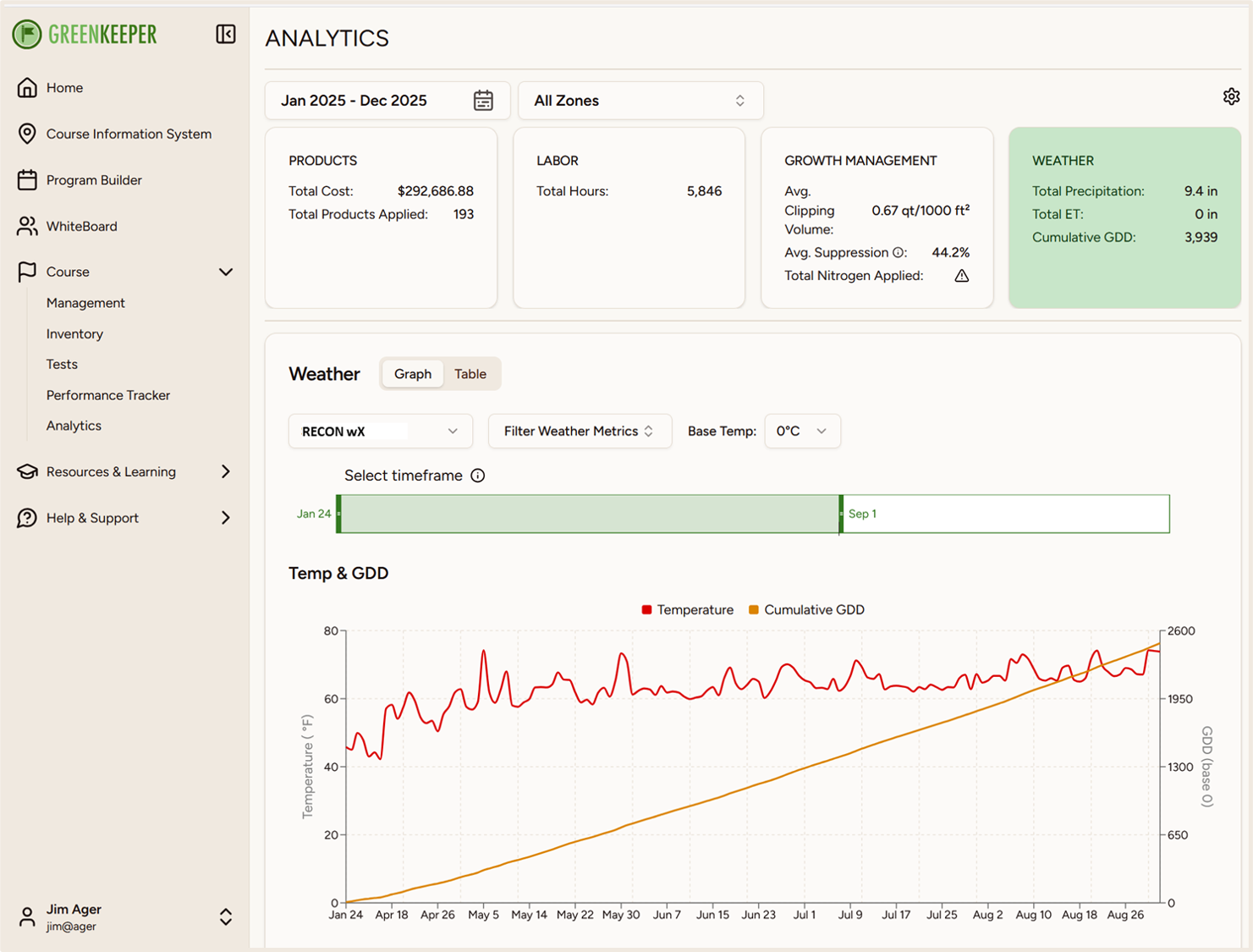
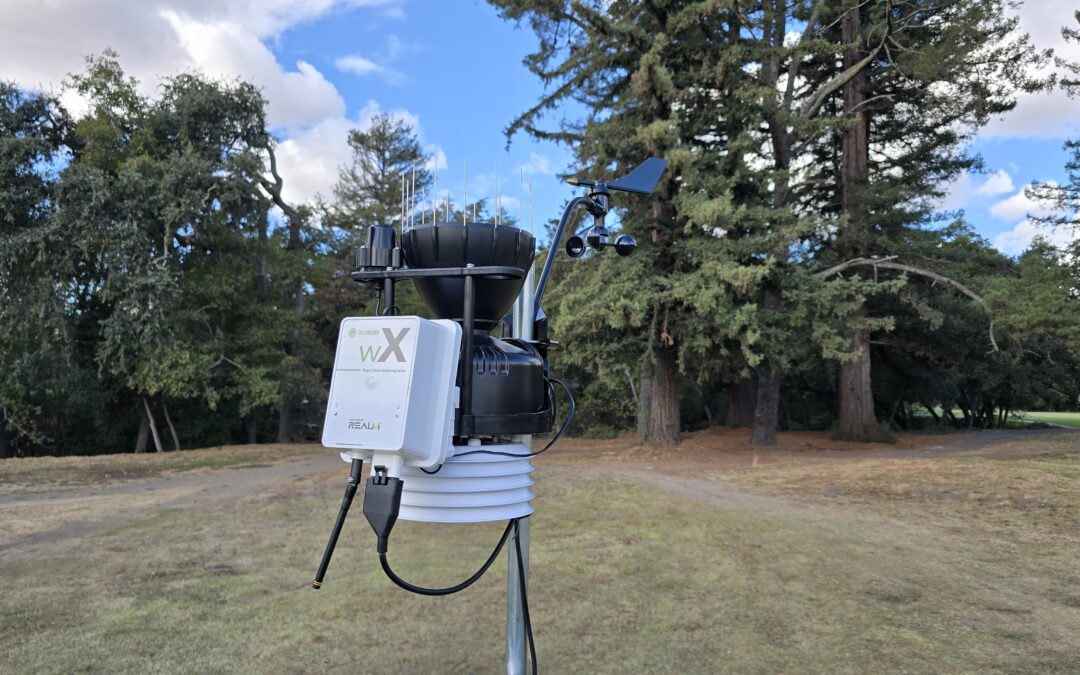
Agronomic models are only as good as the data they receive. GreenKeeper’s models rely on high-quality, site-specific weather inputs to perform at their best. Adding a wX station dramatically improves the accuracy and resolution of those data. While weather stations linked to irrigation controllers are used to calculate yesterday’s evapotranspiration (ET), the wX station provides real-time atmospheric measurements that help predict tomorrow’s water use—a far more actionable number when planning irrigation. These same local data also enhance the accuracy of all GreenKeeper models, including prediction of plant growth regulator performance, pest models, wetting-agent breakdown guidance, and soil organic matter predictions.
Weather stations remain essential tools for golf course and sports turf managers. They document on-site environmental conditions, support better decision-making, and help quantify the impact of management strategies. Too often, these stations have been under-utilized because the data isn’t linked to actionable models. The wX station makes this connection, providing continuous, high-resolution data, updated every 15 minutes, and directly integrated into the GreenKeeper platform. This allows users to make decisions based on what is happening on their property—not weather conditions estimated from weather models or off-site weather stations.
How’s wX Different than a Weather Station Connected to aN Irrigation Controller?
Irrigation-controller weather stations were originally designed to accomplish two main tasks: suspend irrigation when rainfall is detected and estimate yesterday’s ET from the previous 24 hours of weather. Both features serve important roles in preventing over-watering and improving system efficiency. However, using a rain bucket or rain-out switch can accomplish the same shutoff function for a fraction of the cost. When it comes to estimating water requirements for tomorrow, yesterday’s ET has limited predictive value because conditions can change quickly.
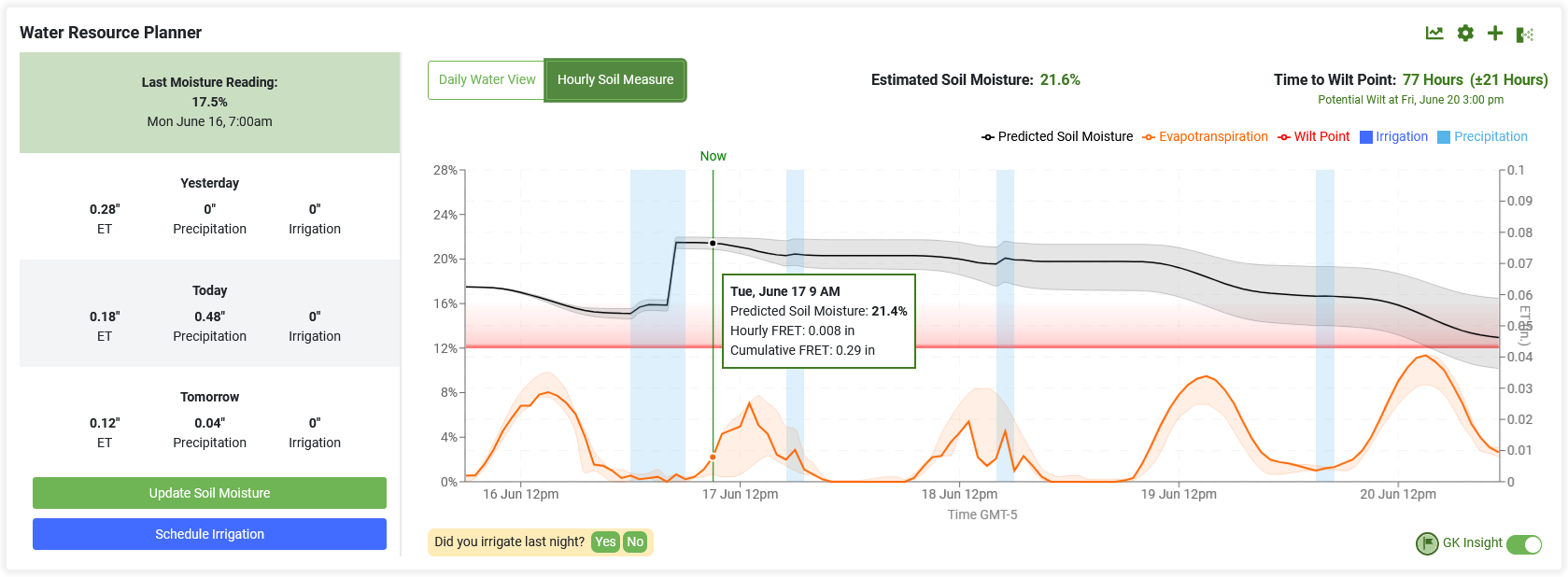
Yesterday’s ET also offers little value when determining tonight’s irrigation run time. Superintendents need to anticipate the remaining water use this afternoon, then decide how much water to apply overnight to avoid wilt the following day. Because yesterday’s ET does not describe today’s evaporative demand or tomorrow’s conditions, it cannot support those mental calculations. The Water Resource Planner solves this problem by forecasting site-specific ET into the future, allowing decisions to be based on expected water use rather than outdated estimates.
This is where GreenKeeper’s Water Resource Planner provides a major advantage. Rather than relying on past ET, it uses advanced modeling and AI-driven forecasting to estimate water demand days into the future using site-specific atmospheric trends. These predictions are far more relevant for scheduling irrigation, especially during periods of rapid environmental change. Combining this forward-looking tool with the high-resolution data from a wX station significantly improves confidence in irrigation planning.
It is much easier for GreenKeeper clients to enter tomorrows predicted ET into their irrigation computer – one simple value – instead of entering 120 hour weather observations from a non-connected weather station into GreenKeeper App each day.
High Resolution and Precision Weather Data to Drive GreenKeeper Models
Beyond irrigation, the wX station strengthens every model inside GreenKeeper. Local solar radiation, humidity, wind speed, temperature, and precipitation measurements refine PGR degradation curves, improve disease and pest forecasts, enhance soil moisture and organic matter models, and support more precise interpretation of sensor data from TurfVision and other integrated systems. Better weather data simply produces better agronomic recommendations.
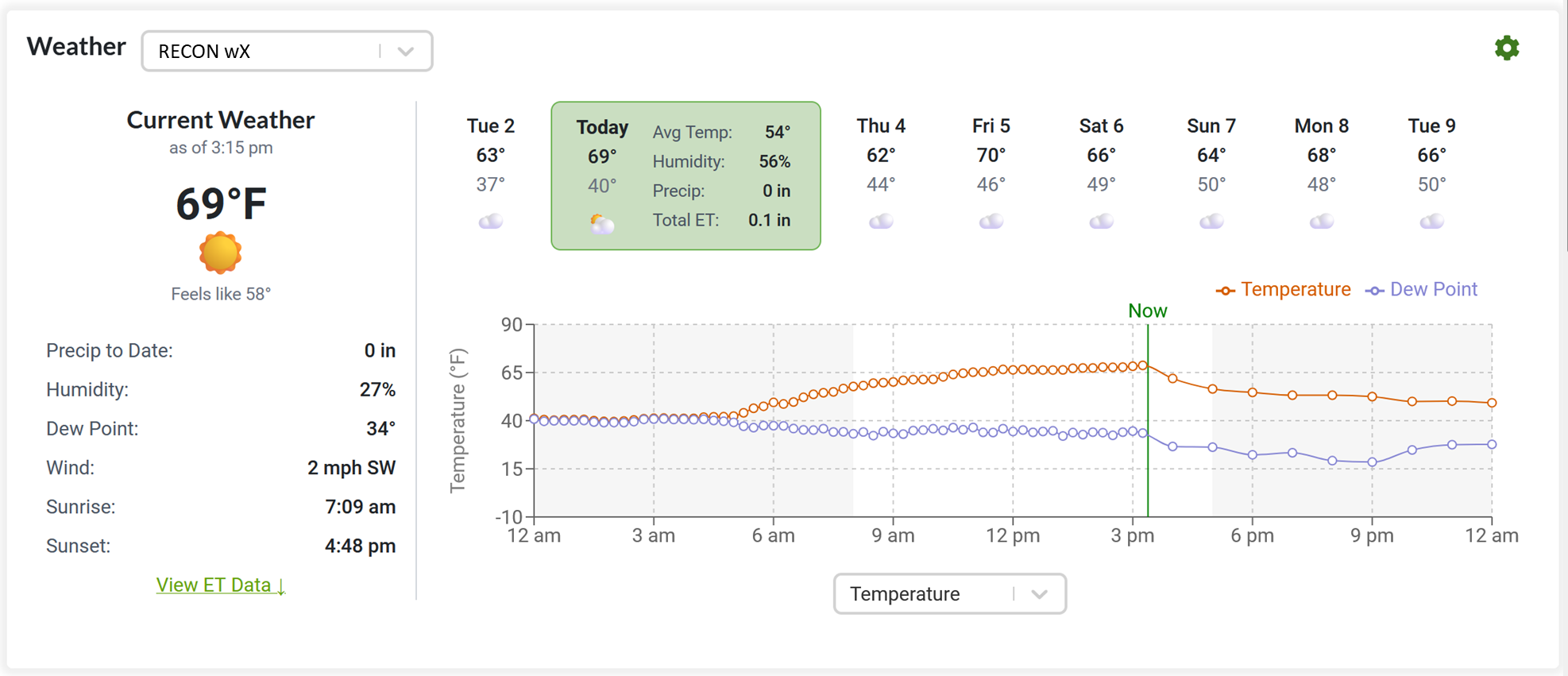
For users considering a weather station upgrade, connecting a wX station to GreenKeeper offers a strong return. It increases the accuracy of every decision-support model, produces better water-use forecasting, and requires no complicated integration with irrigation controllers. Users can simply take tomorrow’s forecast ET from GreenKeeper and enter it into their irrigation computer—faster and easier than importing daily weather logs from a controller-based station into GreenKeeper. The result is a streamlined workflow with substantially better data behind it.
Measurement Capabilities
• Air temperature
• Relative humidity
• Dew point
• Solar radiation for ET
• Wind speed and direction
• Barometric pressure
• On-site precipitation via tipping-bucket rain gauge
Update & Transmission
• 15-minute reporting intervals – immediate reporting when precipitation starts
• Wireless data transmission to cloud via cellular connection – Verizon standard but AT&T verison are available
• Continuous data archiving for long-term modeling
• Automated synchronization with GreenKeeper models
Physical Specifications
• Rugged, UV-resistant outdoor sensor suite
• Integrated radiation shield
• Increases robust wX tripod with screw in anchors for longevity in any location
• Designed for year-round exposure in extreme environments
Pricing
Pricing & Subscription
The RECON wX weather station is priced at $4,000, which includes the first year of data service (covering all cellular access fees). After the first year, the annual Data Subscription is $350 and is renewed along with your GreenKeeper Essential or Pro subscription.
GreenKeeper Pro Vision users—who also benefit from our CIS software—receive one free Data Subscription for their first wX station.
Satellite Rain Buckets
Up to 50 Satellites Rain Buckets can connect to wX Stations – sharing one cellular subscription to broadcast precipitation data to GreenKeeper.
Rain Buckets can be placed 750+ meters away from the wX station, if line-of-sight is maintained.
Rain buckets are a one-time cost of $900 and have no annual API access fee. Data is transmitted over LoRa connection to the wX Station and share over that device’s cellular connection.