

GreenKeeper Surface Organic Matter Series · Part 2
In the first article of this series, we explored how much surface organic matter could realistically change under a typical cultivation and topdressing program. One of the more interesting findings was that the same management program could increase surface organic matter on a green starting at 2% while reducing it considerably on a green starting at 10%. The starting surface organic matter concentration had a substantial influence on the projected response.
The expected change in surface organic matter from a year of cultivation and topdressing depends on the starting point. That raises an important question: What should we consider a normal surface organic matter concentration in the first place? More importantly, if a superintendent wants to maintain organic matter below the average, how much additional management might that require, and does a lower number necessarily produce better playing conditions?
What Is a Normal Surface Organic Matter Concentration?
GreenKeeper users have been recording organic matter test results for several years, providing an opportunity to examine actual measurements across golf courses rather than rely on historical assumptions. We recently completed an audit of the GreenKeeper Surface Organic Matter Testing Database, removing demonstration accounts, questionable values, duplicate records, and non-putting-green samples.
For cool-season putting greens, the median organic matter concentration in the upper inch was 3.8%, with the middle half of putting-green populations ranging from 2.4% to 5.6%. The analysis included 129 separately managed putting-green populations representing 124 golf courses. Organic matter declined considerably with depth, with median concentrations of 2.2% in the second inch and 1.7% in the third inch.
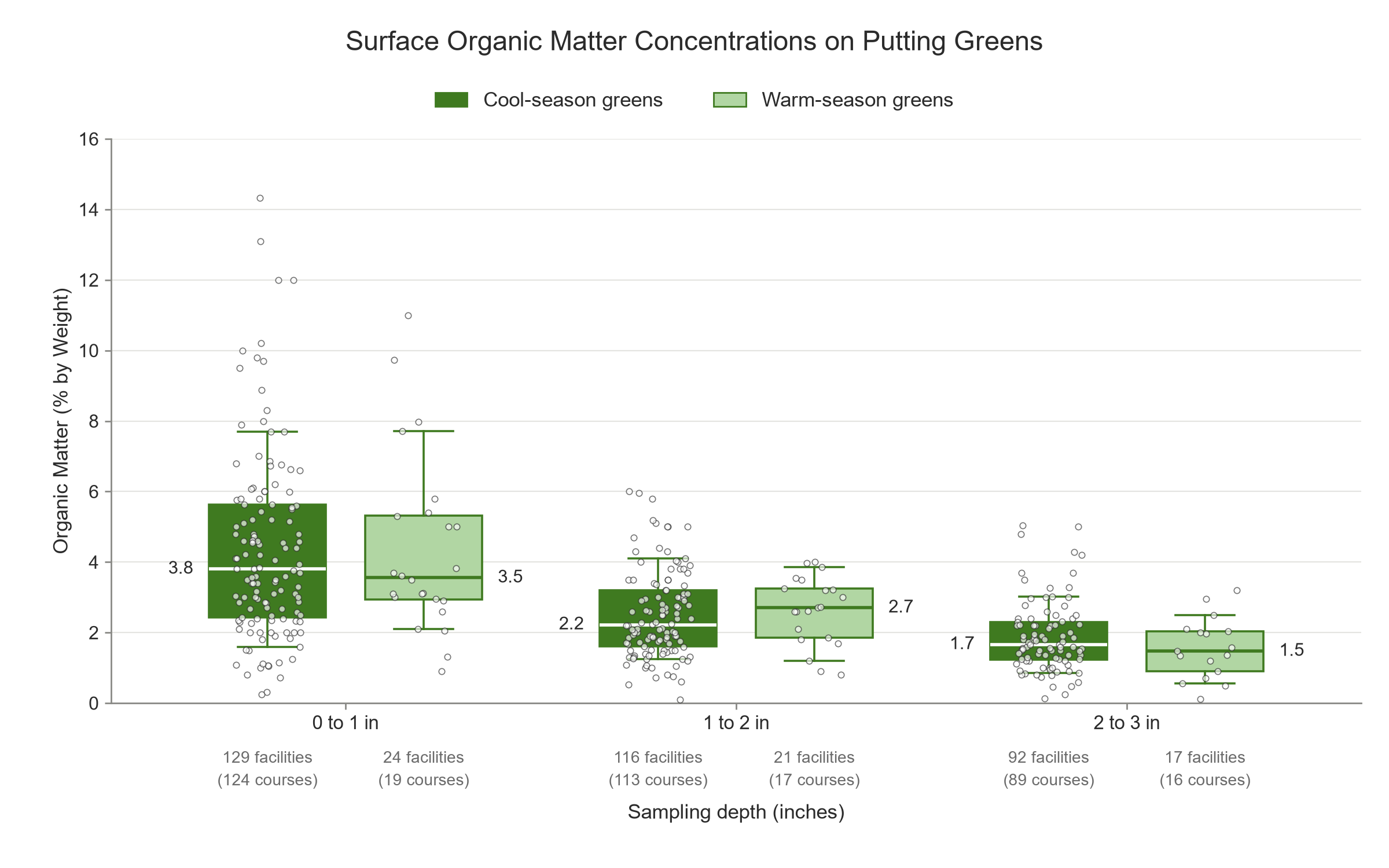
Figure 1. Surface organic matter concentrations on putting greens, showing distributions by sampling depth, individual facilities, medians, and sample counts. The cool-season data are the primary focus; warm-season results are included for context. Source: GreenKeeper App Surface Organic Matter Testing Database, October 2026.
The distribution is particularly interesting because it demonstrates how widely organic matter concentrations vary among courses. Some greens contain less than 2% organic matter near the surface, while others exceed 8% or even 10%. These results are not necessarily evidence that one superintendent is managing organic matter better than another. Greens differ in their construction, growing environment, turfgrass species, age, and maintenance history.
The sampling method also matters. Our database analysis uses the inch-based or 0-2 cm depth intervals reported through GreenKeeper, bulk soil organic matter sample results from tranditional soil sampling methods. The USGA’s standardized sampling guidance emphasizes consistent sample preparation, depth, and timing. Neither our observations nor the USGA’s published research establishes a universal target that every golf course should pursue.
Why Maintaining Low Organic Matter IS SO Difficult
This brings us back to the modeling exercise from Part 1 of this series (How Much Can Surface Organic Matter Change in a Year?) . A cultivation and topdressing program that successfully reduced organic matter on a green that starts at 10% actually allowed organic matter to accumulate on a green that starts 2%. In that example, the lower-organic-matter green increased to 3.9% after three years, while the higher-organic-matter green declined to 6.4%.
The explanation involves the balance between organic matter accumulation and dilution through sand topdressing and cultivation. On a green with considerable accumulated organic matter, replacing or mixing existing material with sand can produce a relatively large reduction in organic matter concentration. As that concentration declines, the same quantity of sand generally produces a smaller change in the measured percentage. Meanwhile, the turf continues producing new organic material.
Consequently, maintaining a green well below the observed average may require a more intensive or consistent topdressing program than maintaining a green at a higher concentration. That does not mean a low-organic-matter target is wrong. It means that the management inputs needed to achieve that target should be considered alongside the expected performance benefits.
Dr. Doug Soldat reported a particularly useful example in his March 2025 GreenKeeper article. During a three-year Wisconsin creeping bentgrass putting green study, annual sand applications of 26 versus 14 cubic feet per 1,000 square feet produced surface organic matter concentrations of 4.4% and 6.2%, respectively. The higher sand rate also reduced soil moisture, but the treatments produced similar green speed, turf quality, and other measured performance characteristics, without a clear firmness difference.
These findings, reported in GreenKeeper from ongoing university research, are an important reminder that lower organic matter is not automatically synonymous with better playing conditions. Moisture, surface firmness, sand characteristics, and the turfgrass canopy all contribute to performance. The appropriate organic matter concentration is one that supports the desired playing conditions without requiring unnecessary inputs or compromising turf quality.
How Much Does Organic Matter Actually Change Between Years?
We also examined repeated organic matter measurements from the same putting greens, generally collected approximately one year apart. Across 82 consecutive sampling pairs from 49 greens at 21 golf courses, the median change in the upper inch was effectively zero. The middle half of the observations changed between −0.6 and +0.6 percentage points, and 62% changed by less than one percentage point in either direction.
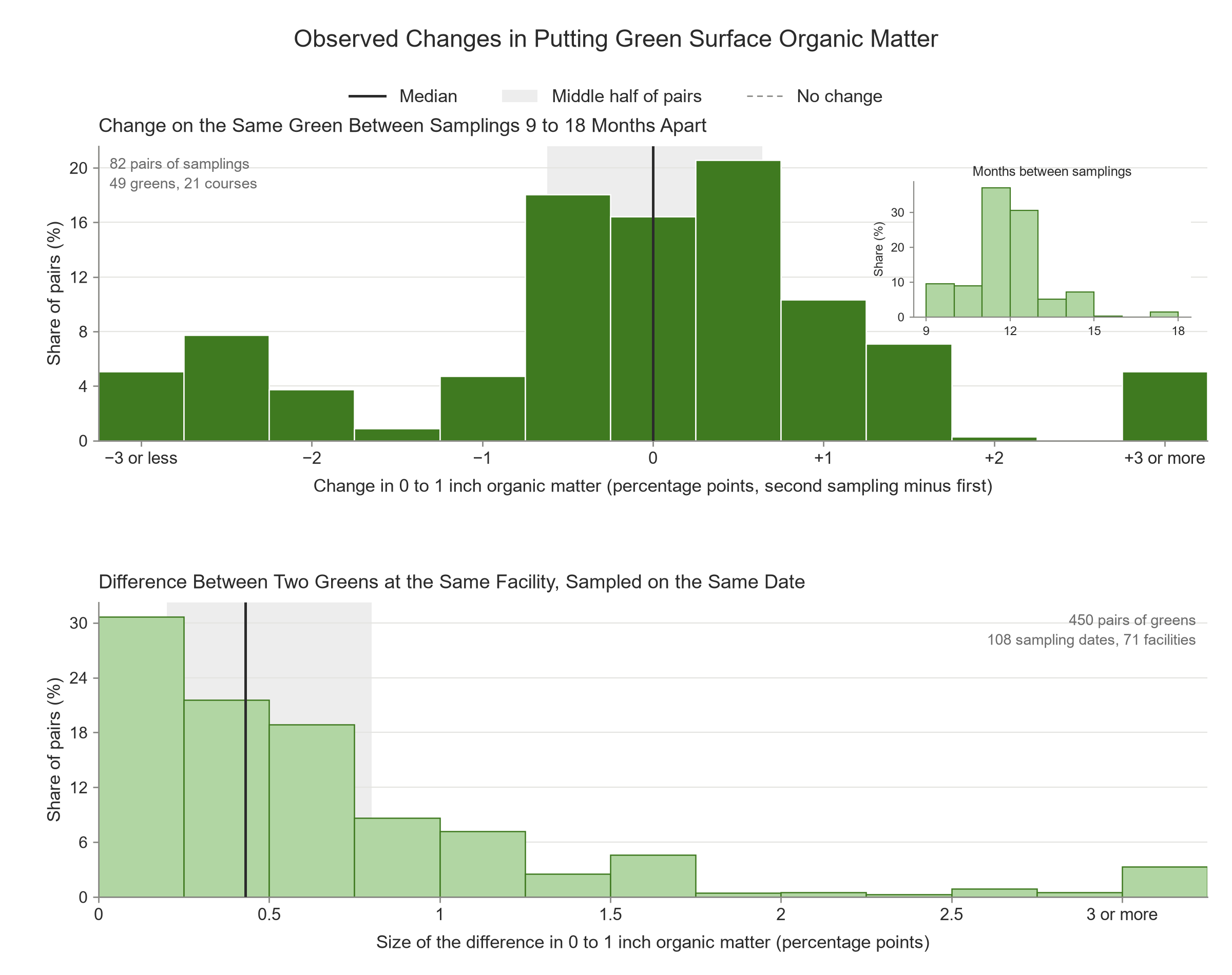
Figure 2. Observed changes in putting green surface organic matter, showing year-to-year changes on individual greens alongside the differences among greens within the same facility. Source: GreenKeeper App Surface Organic Matter Testing Database, October 2026.
Those relatively small changes reinforce the importance of consistent testing, but they should not be interpreted as evidence that organic matter cannot change substantially over a year. Cultivation, topdressing, weather, and growth can all alter the organic matter balance. Sampling and laboratory variability can also affect measured changes, and our dataset does not include the same-day replicate samples needed to separate measurement variability from actual changes.
Another interesting finding was the variation among greens at the same facility. When we compared greens sampled during the same testing campaign, the median difference between two greens was 0.43 percentage points, and approximately one in six pairs differed by more than a full percentage point.
That is meaningful when deciding which greens to sample and how to interpret the results. A superintendent testing only one or two greens may obtain a useful starting point, but those samples may not fully represent the facility. Monitoring the same representative greens, using the same sampling method and seasonal timing, provides a much stronger basis for evaluating changes over time.
Set the Goal From Measurements, Not an Average
The practical question is not whether a course is above or below the 3.8% median. It is whether the current organic matter concentration is contributing to undesirable playing conditions and whether the proposed cultivation program is likely to produce a worthwhile improvement.
A superintendent maintaining firm, consistent greens at 6% organic matter may have little reason to pursue an aggressive reduction simply because other courses report lower values. Conversely, a green with 3% organic matter may still benefit from changes in cultivation or topdressing if surface conditions warrant them. This is particularly important if there is a buried layer or other soil texture discontinuity that can benefit from removal and sand incorporation.
That is where the GreenKeeper Cultivation Tool becomes particularly useful. Rather than applying a universal sand-rate recommendation, users can start with their measured organic matter concentrations, enter their actual cultivation and topdressing practices, and compare projected outcomes over the next three years. The model provides a way to evaluate what different programs might accomplish before committing the labor, sand, equipment, and playing disruption needed to implement them.
As we approach 2027, fall is an excellent opportunity to establish or update that baseline through GreenKeeper Surface Organic Matter Testing. Consistent measurements, paired with cultivation records and playing-performance observations, make it possible to develop a plan around the conditions and expectations of an individual golf course.
The objective is not to achieve the lowest possible organic matter percentage. It is to understand what is present, determine whether it is affecting performance, and develop a practical management program that produces the conditions your golfers expect.
References and Additional Reading
Gaussoin, R., D. Linde, J. Murphy, D. Soldat, and B. Whitlark. 2024. A standard method for measuring putting green surface organic matter. USGA Green Section Record 62(2).
Hartwiger, C. 2024. Are you managing putting green organic matter or is it managing you?. USGA Green Section Record 62(22).
Kahiu, M.M., M.S. Woods, J.C. Booth, B.J. Horvath, and J.T. Brosnan. 2024. Organic matter and nutrient content within putting green root zones in Tennessee. Agron. J. 116:2862–2871.
Soldat, D. 2025. Optimizing putting green performance with the new surface organic matter test. GreenKeeper App, 11 March 2025.