
GreenKeeper Surface Organic Matter Series · Part 1
Scheduling cultivation and topdressing is always a tricky and sometimes controversal task. These practices are disruptive to players, costly, and tough on turf equipment. How much cultivation is really required? What’s the right amount of sand topdressing for a putting green? Are there tools exist to help justify these decisions? This new mini-series helps to answer these questions.
A couple of weeks ago, a turfgrass professor asked me a question that sounded simple: How much can a golf course superintendent realistically expect surface organic matter to change in a year? His initial thought was that it would be difficult to quantify. The greens committee member asked AI and it provided an answer of 0.6%. Then they asked where that number came from. The AI chatbot said it basically made it up based on its own assumptions.
Surface organic matter changes slowly, weather varies, cultivation programs differ, and small year-to-year differences can be difficult to separate from sampling variability. Superintendents rarely forego annual cultivation or topdressing to see what’s going to happen, so it is difficult to answer this fundamental question.
GreenKeeper has a much better model that generic AI chat bot. It is designed to explore exactly this kind of question. So rather than answer with a generic sand-rate recommendation, I built an example cultivation program in the GreenKeeper Cultivation Tool and ran the same program from several very different starting conditions.
One program, four very different starting points
For this example, I used a bentgrass putting green in Lincoln, Nebraska with GreenKeeper weather normals and the High (Greens) organic matter accumulation setting. The program included hollow-tine coring in April and September using 1/2-inch tines on 2 x 2-inch spacing, along with nine sand topdressings totaling approximately 0.18 inch of sand depth per year.
Then I changed only one thing: the starting surface organic matter percentage in the top inch.
The projected response changed substantially. A green beginning at 2% surface organic matter increased to 2.9% after the first year and 3.9% after three years. Starting at 4% produced much less movement, reaching 4.3% after one year and 4.6% after three. A green beginning at 7% moved in the opposite direction, declining to 5.6% after three years, while one beginning at 10% declined to 6.4%.
The exact same cultivation and topdressing program increased organic matter on the leanest green while substantially reducing it on the highest-organic-matter green.
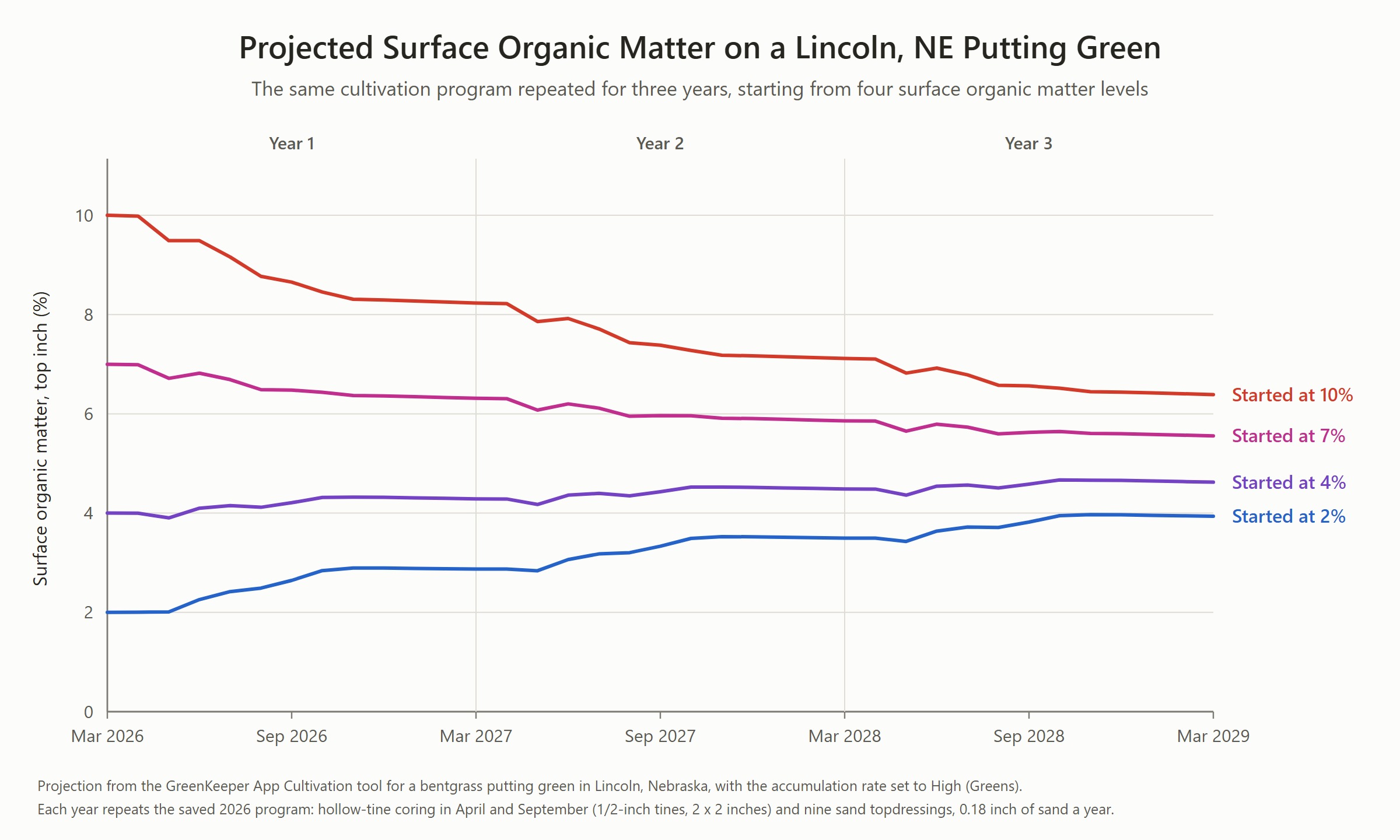
Figure 1. GreenKeeper projection for the same Lincoln, Nebraska cultivation program repeated for three years from four starting surface organic matter concentrations. The example is illustrative, not a universal recommendation.
The first year does not tell the whole story either. The green scenario with 10% surface organic matter at the start declined most rapidly during year 1, then the rate of change slowed as surface organic matter fell. The 2% green followed the opposite pattern, accumulating organic matter rapidly during the first year and the it slowed over the next two years. The response is dynamic because the condition of the green is changing while the program continues.
That is the first practical lesson from this exercise. A cultivation program cannot be described as inherently aggressive or conservative without knowing the starting surface organic matter and the goal longterm surface organic matter percentage.
Why the starting level changes the response
The GreenKeeper projection builds on the organic matter mass-balance concepts developed through the McCoy and Broadbelt work and has since been refined within GreenKeeper. Conceptually, the model is balancing several processes at the same time.
Turf continually contributes new roots, shoots and other plant material. Some existing organic material decomposes through biological and soil processes. Weather influences those processes, while cultivation and sand alter the amount and concentration of organic material in the surface profile.
That dilution effect is one reason the starting concentration matters so much. Adding nearly organic-matter-free sand to a surface containing a high concentration of organic matter has a different effect than applying the same amount to a very lean surface that is still accumulating plant-derived material.
The important result is not that this particular Lincoln program will produce these exact numbers everywhere. It is that the answer changed when only the starting condition changed. That is why surface organic matter management is difficult to reduce to a universal annual sand rate.
This is what the Cultivation Tool is built to explore
Once a measured Surface Organic Matter result is in GreenKeeper, the Cultivation Tool can use that measured profile as the starting point for a plan. Users can build the cultivation program they are actually considering, adjust sand applications, change cultivation timing and compare how those decisions are projected to influence surface organic matter over several seasons.
The same page also converts the planned topdressing program into cumulative sand by weight or depth. That makes it easier to connect an agronomic goal with the program the crew will actually execute rather than relying on a single generic annual recommendation.
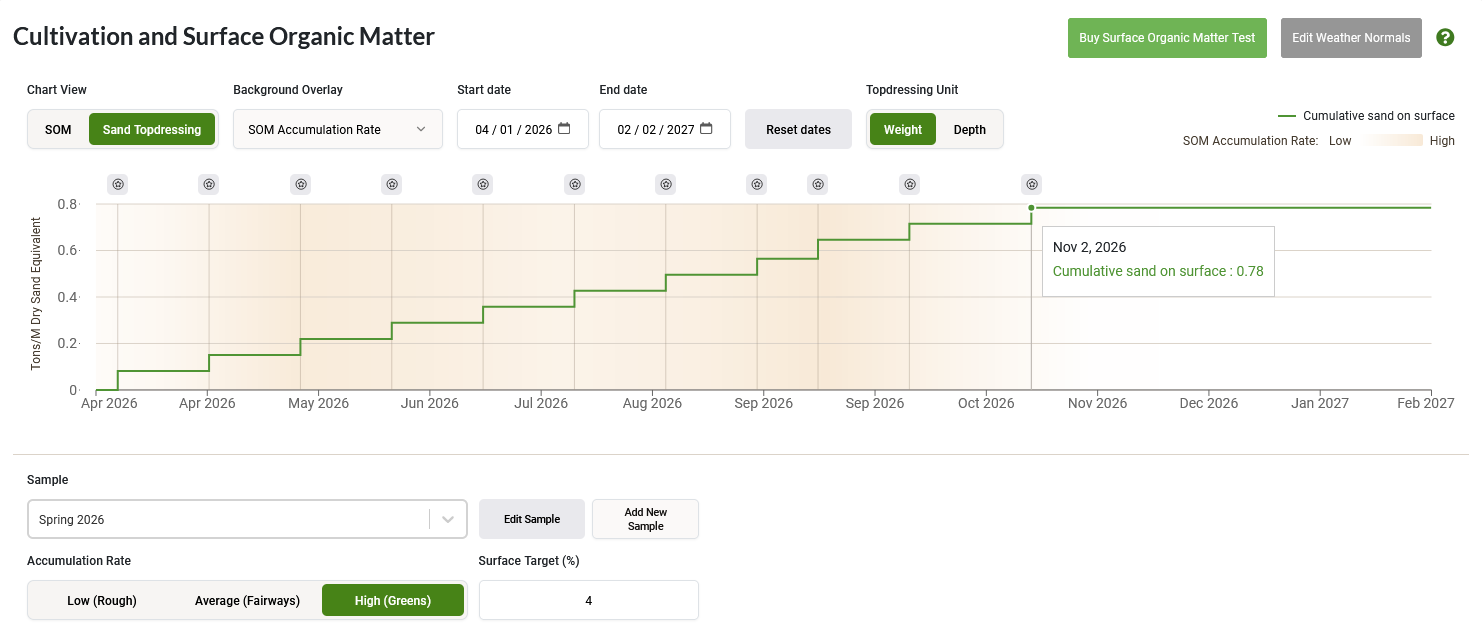
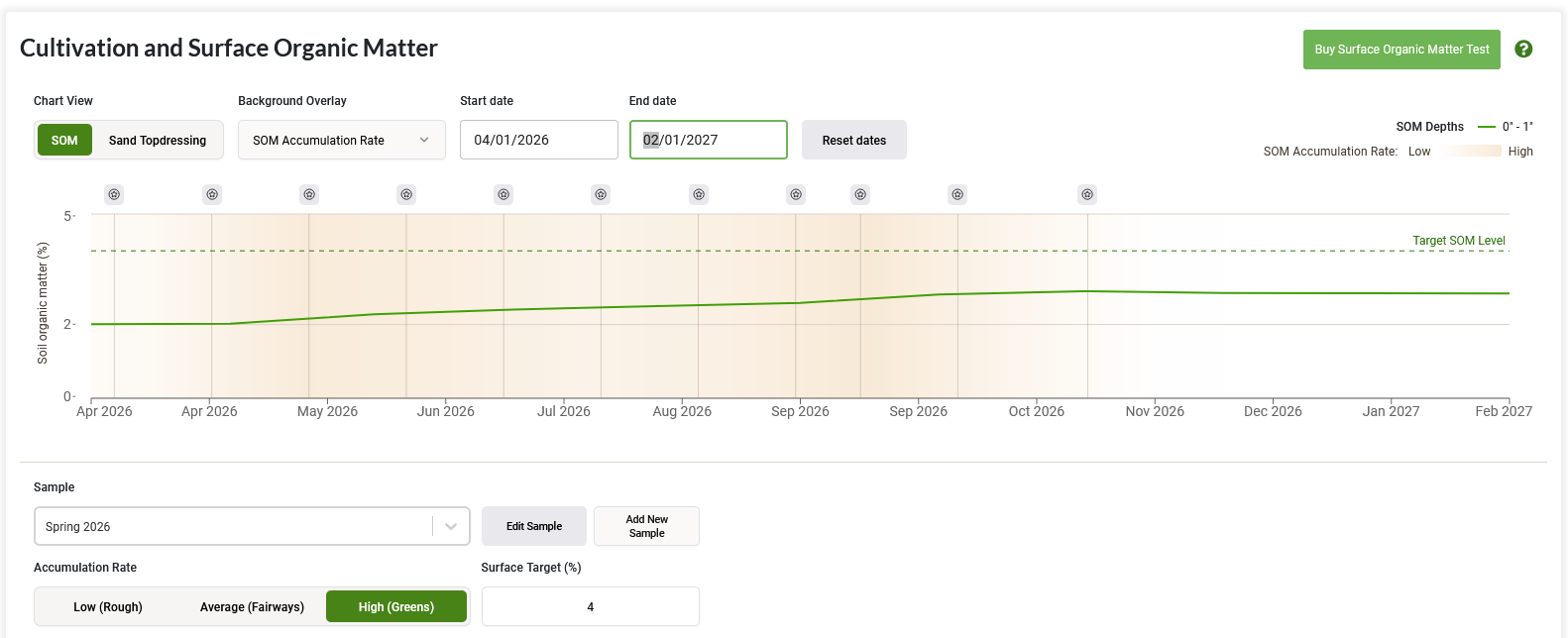
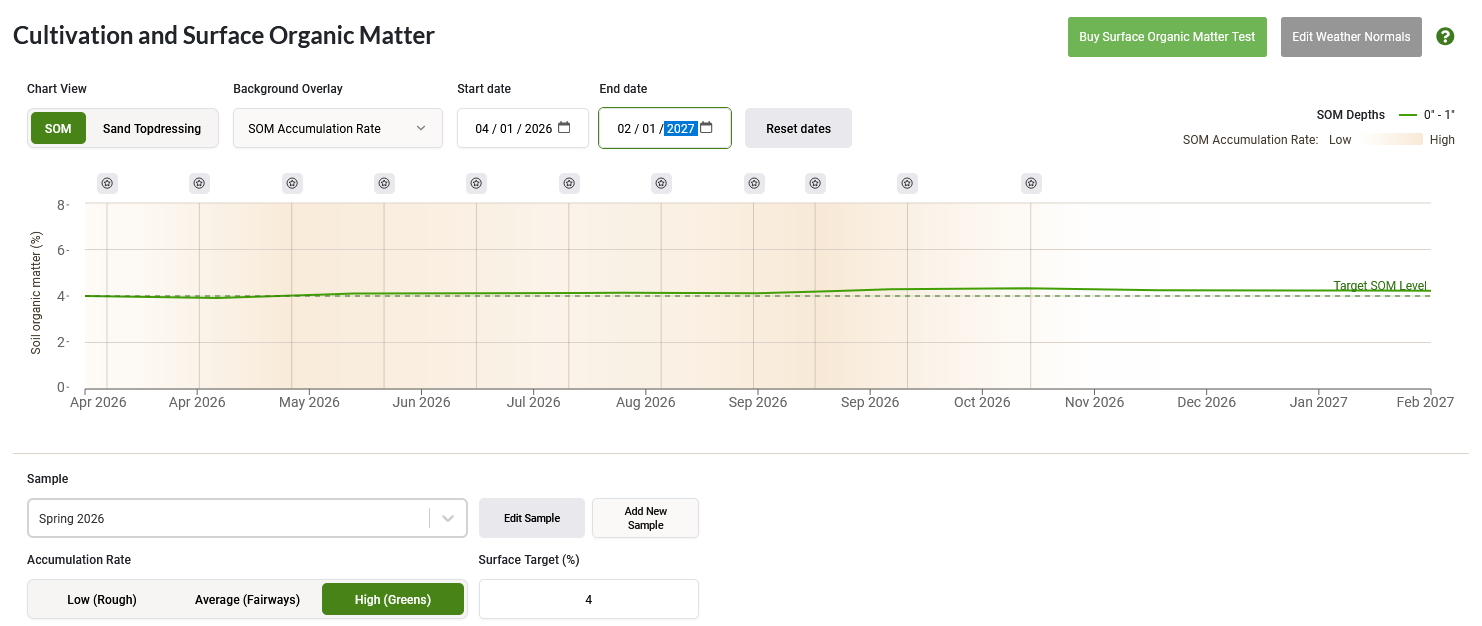
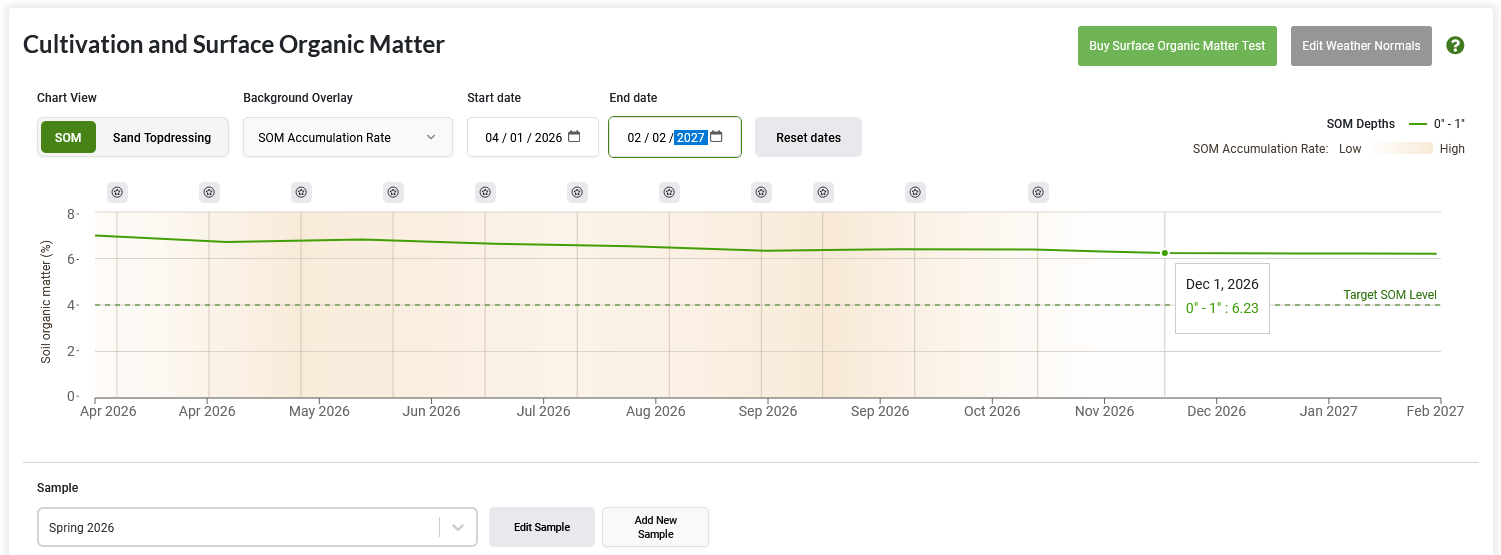
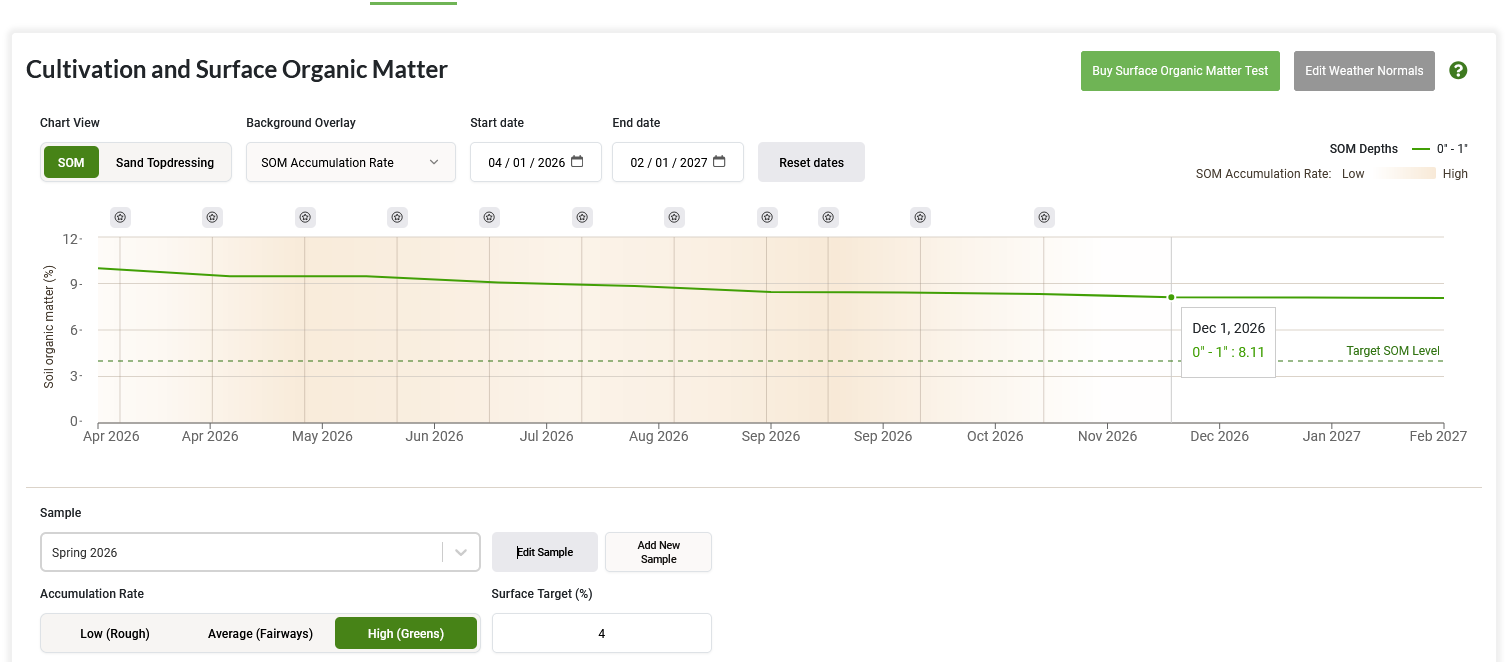
Figure 2. Screenshots of GreenKeeper App’s Cultivation planning tool within Program Builder. View cumulative sand application in depth or weight and monitor how surface organic matter is projected to change into the future. The starting scenarios for top inch organic matter shown include 2%, 4%, 7.5%, and 10%.
Think in trajectories, not recipes
The most useful question is not, “How many tons of sand should a golf course apply?” It is, “Where are my greens today, where do I want them to go, and is the program I am planning likely to move them in that direction?”
That distinction matters because maintaining an acceptable surface is different from trying to correct one that has accumulated too much organic matter. It also means the plan should be revisited as new measurements come in. Repeated testing, using the same sampling depth, timing and locations as consistently as possible, helps determine whether the longer-term trajectory is matching the management goal.
GreenKeeper is intended to provide that context. The model does not replace the superintendent’s observations or the next laboratory measurement. It gives those measurements a planning framework and lets users compare realistic programs before committing to them.
Measure this fall. Build the 2027 plan.
If you have not measured surface organic matter recently, this fall is a good time to establish or update the baseline. Surface Organic Matter Tests can be purchased directly from the Cultivation Tool: Learn How. Once the results are returned to GreenKeeper, those measurements become the starting point for building and comparing your 2027 cultivation program.
Dr. Doug Soldat has also been evaluating the GreenKeeper organic matter modeling approach at the University of Wisconsin-Madison with encouraging results. As more courses repeat their sampling and maintain complete cultivation records, those measurements will also help us continue improving the models.
The goal is not to chase a universal percentage or copy someone else’s sand rate. It is to know where your greens are, decide where you want them to go, and use GreenKeeper to build a plan around your own measurements.
This simulation answered the original question, but it also created the obvious next one: What should we consider a normal surface organic matter concentration in the first place?
In the next article in this series, we will use GreenKeeper Surface Organic Matter testing data to put some context around that question—while being careful not to confuse an emerging dataset with a universal agronomic target