
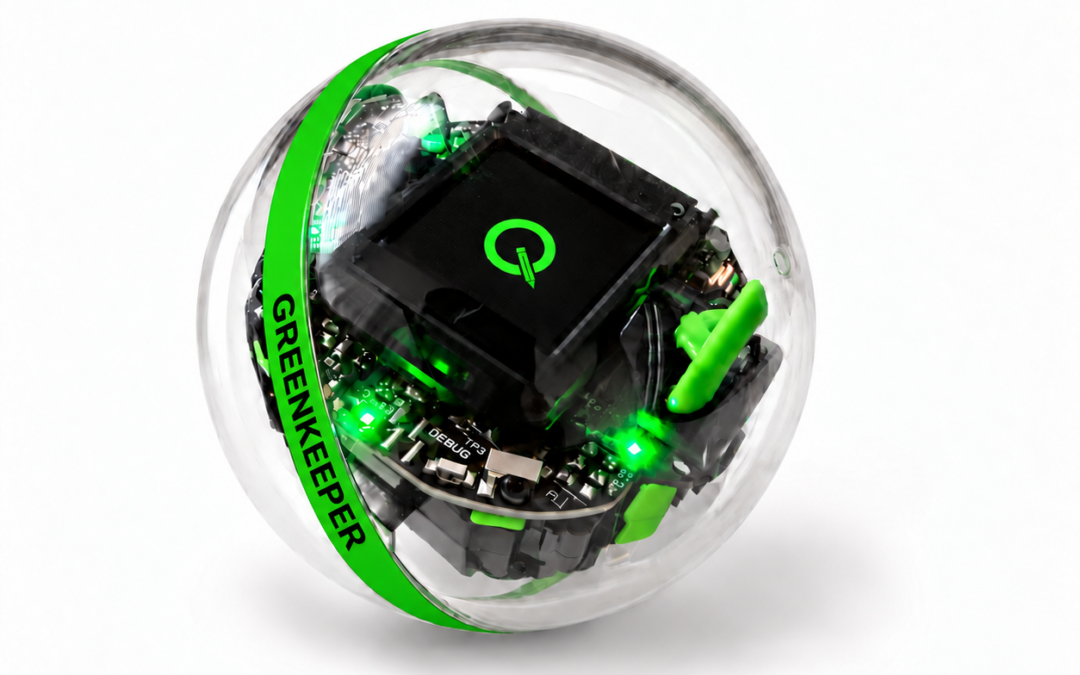
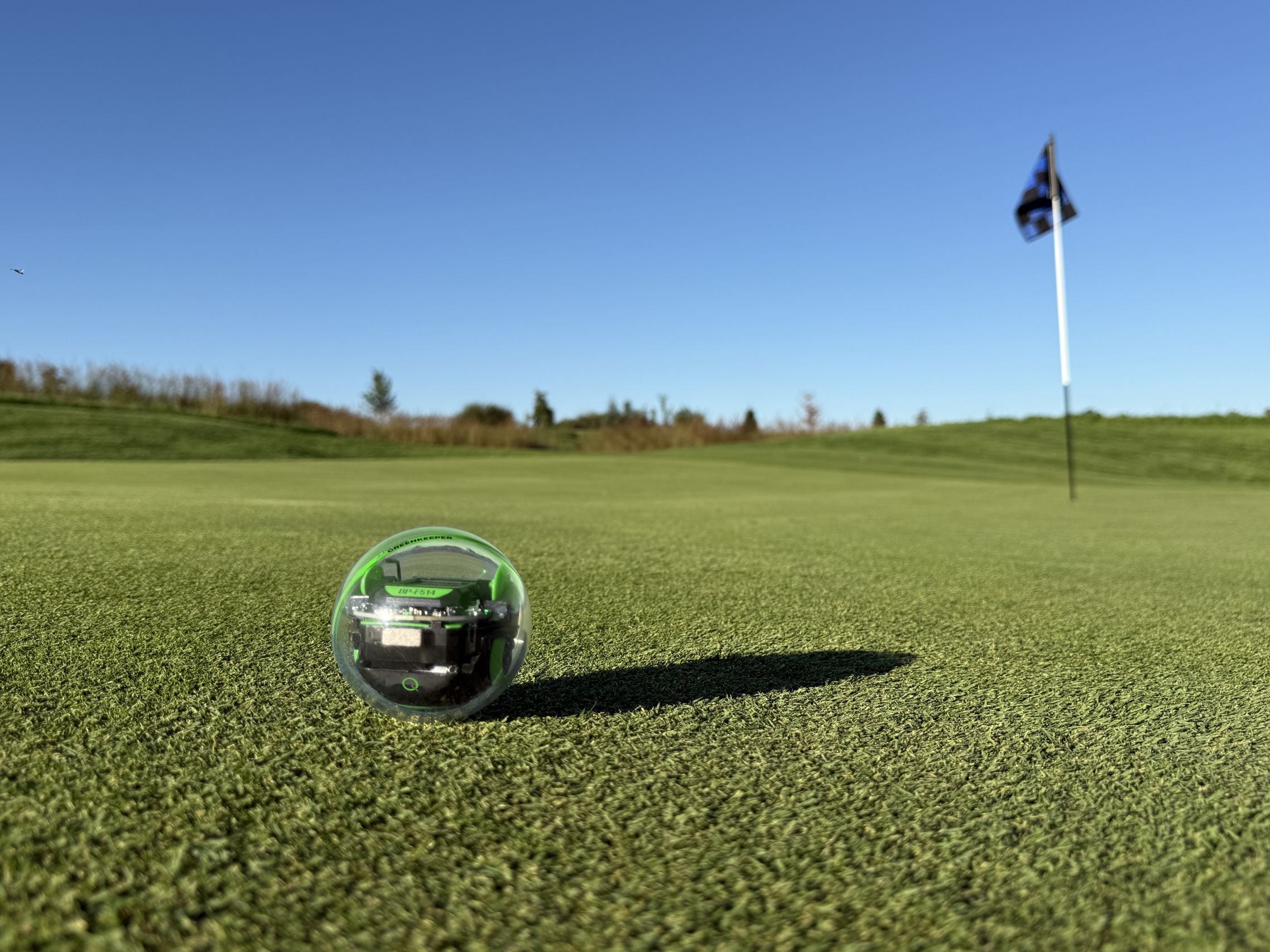
While GreenKeeper Q looks fun to use—and it is—inside its clear shell is a robotic measurement platform that represents a major departure in putting green performance measurement. For decades, golf course superintendents have largely measured greens performance by measuring golf ball roll distance. Q is different. Its onboard sensors allow it to measure what is happening while the ball rolls. As Q moves across a putting surface, it records 19 different motion measurements—including position, acceleration, gyroscopic motion, pitch, yaw, and roll—every 15 milliseconds. These data are then processed through GreenKeeper’s patent-pending physics engine to quantify the conditions influencing ball movement.
Moving Beyond a Stopping Distance
The traditional method for measuring green speed is elegantly simple. A golf ball leaves a standardized ramp with a repeatable amount of energy, slows as it interacts with the putting surface, and eventually stops. Measuring that distance transformed something subjective—these greens feel fast—into an objective number that helps superintendents make management decisions.
The limitation is that the final distance combines everything that happened during the roll into a single measurement. Grass leaves, topdressing sand, surface imperfections, changes in slope, and other interactions all influence the velocity of the ball before it eventually stops. If a ball encounters a small imperfection one foot into a 10-foot roll, that interaction affects the remaining nine feet of travel. We know where the ball eventually stopped, but the stopping distance alone cannot tell us exactly where or why its movement changed.
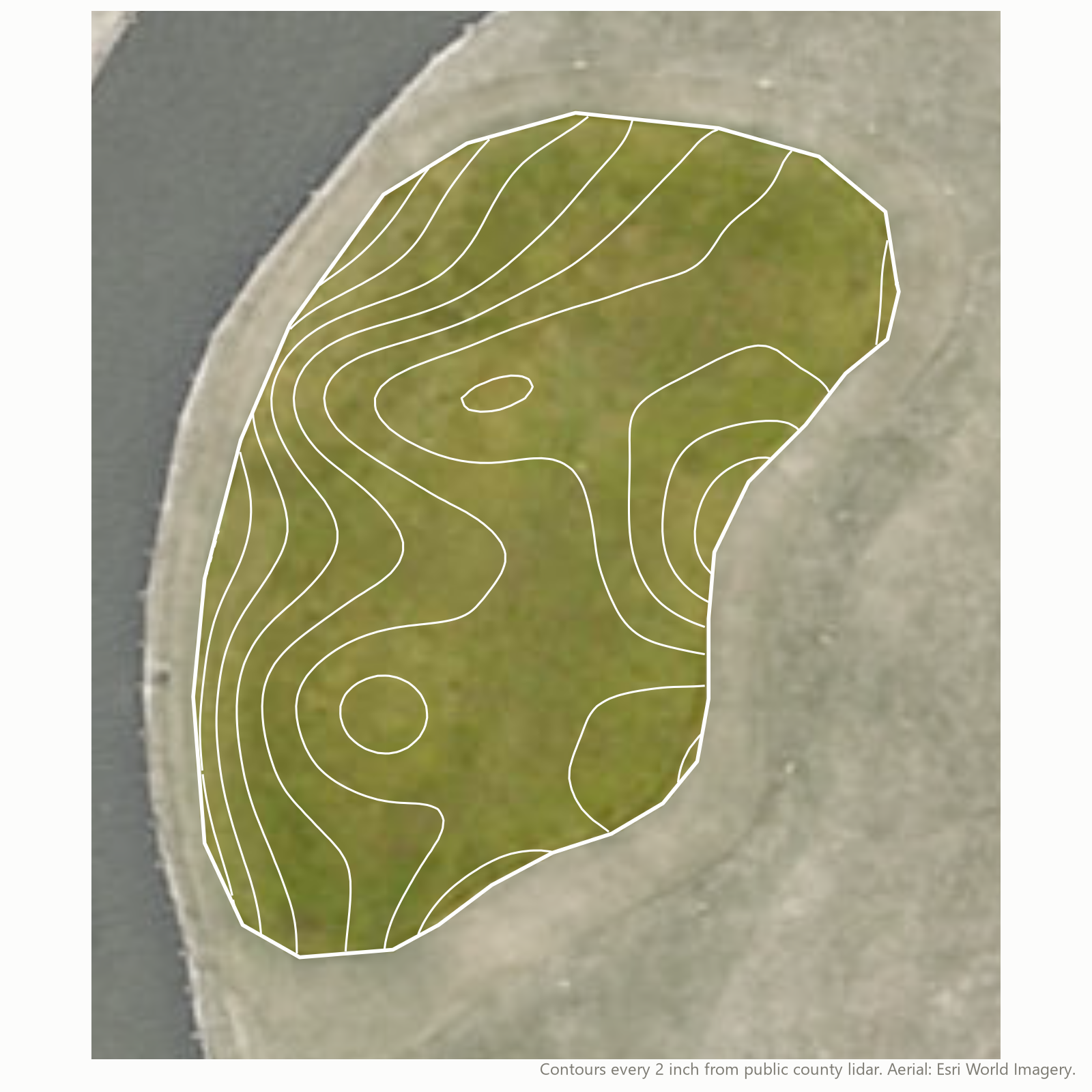
Figure 1. Putting green contours shown at 2-inch elevation intervals. Even modest elevation changes create a wide range of slopes across a putting surface. Slopes like these make traditional green speed measurement techniques difficult to impossible at fast green speeds.
Faster and more undulating putting greens also make suitable measurement areas hard to find. Shorter roll methods and slope corrections have been developed over the years to help address that issue, but they still center around the same basic concept: give the ball starting energy and measure the final outcome (roll distance). Q approaches the problem differently by actively controlling the ball throughout the measurement.
Measuring What Happens During the Roll
When operating Q in Green Speed mode, it travels forward and backward over roughly two meters of the putting surface twice. Rather than receiving one initial push and passively slowing down, the robot continually adjusts its motor output to maintain a controlled velocity (speed and direction). If the turf creates more resistance, Q applies more force to maintain a constant speed. When it travels uphill, gravity adds resistance; downhill, gravity assists the movement. If the ball encounters a topdressing particle, aeration hole, verticut line, or other surface disturbance, the sensors record that change as it occurs.
A normal measurement produces more than 1,200 snapshots of the forces and movement in less than 18 seconds of measurement time. GreenKeeper’s physics engine uses those data to separate the effects of slope from the resistance created by the putting surface. It displays those final metrics as equivalent green speed, surface slope, and roll quality within GreenKeeper App. A short disturbance remains a short disturbance instead of changing the velocity of the ball for the remainder of a long passive roll. This leads to higher measurement precision and accuracy.
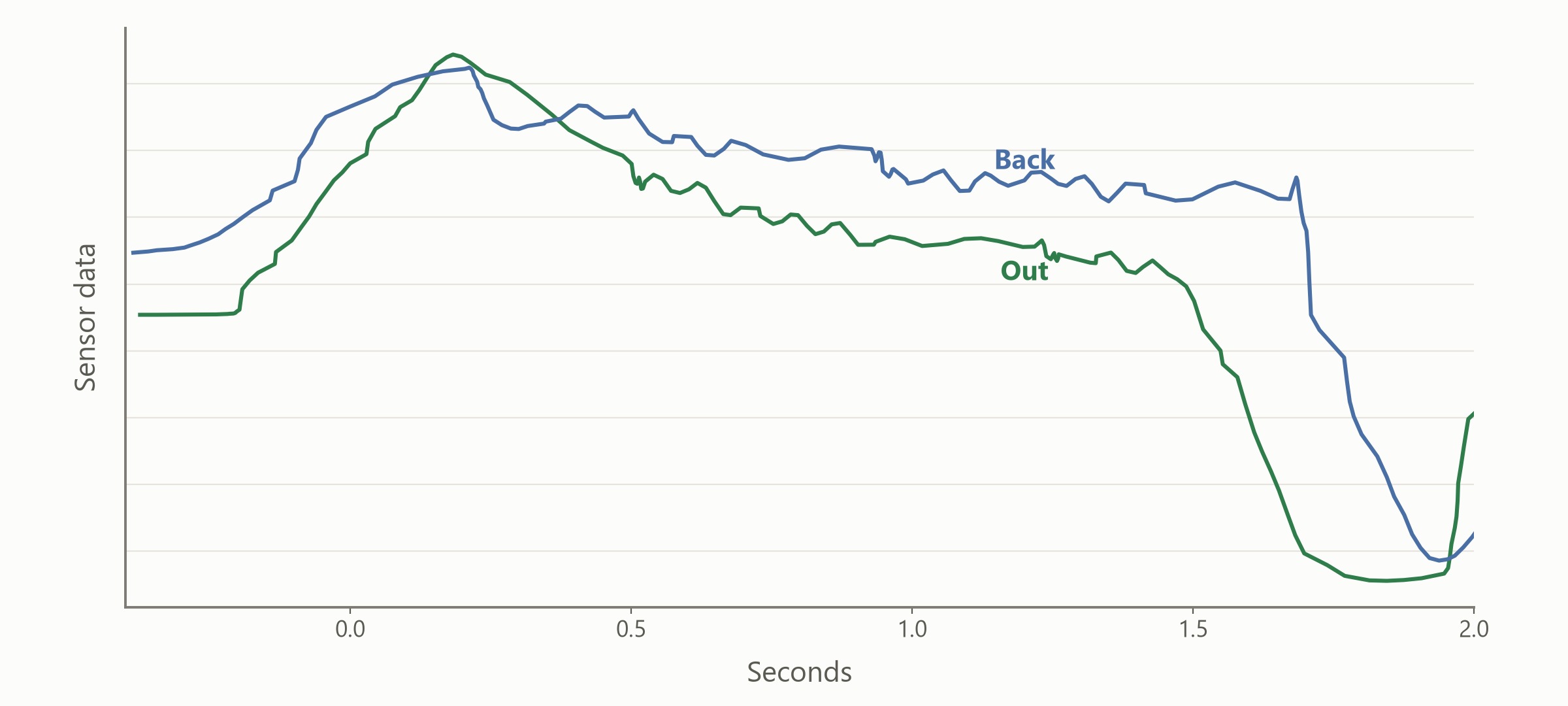
Figure 2. Example of one of the nineteen pieces of sensor data collected as GreenKeeper Q travels out and back during a Green Speed measurement.
Q does not require a perfectly flat test area to estimate green speed. If a putting surface would produce a 10-foot green speed when perfectly level, our goal is for Q to report that same value when operating across a reasonable slope because the force of gravity acting on the ball can be accounted for within our physics-based model.
Can GreenKeeper Q Measure Slope?
One of the first questions about a new measurement system is whether those calculated values actually represent what is happening on the green. Surface slope provides a particularly clean way to test that because we can measure the same path independently with a level and inclinometer.
In a recent verification test, we operated Q across putting green areas ranging from approximately 0.3% to 4.3% slope while green speed was approximately 10 feet. We then independently measured the slope of those same roll paths. Q’s estimates closely matched the measured slopes across the entire range, with an R² of 0.9922.
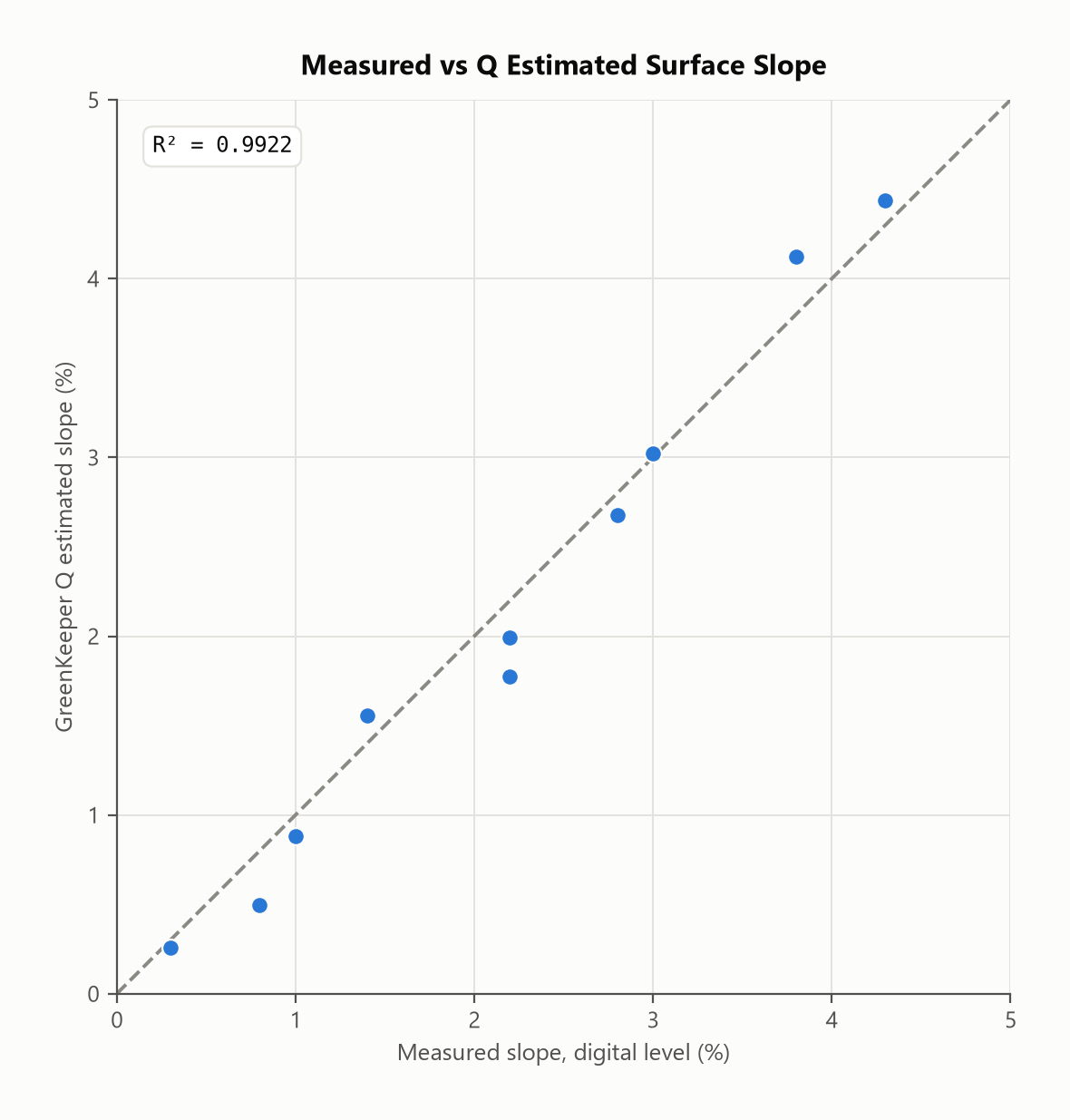
Figure 3. Relationship between independently measured surface slope and slope estimated by GreenKeeper Q. The dotted line represents perfect 1:1 agreement. R² = 0.9922.
The value of that result goes beyond showing that Q can measure slope. Because slope is one of the physical forces acting on the ball, accurately estimating it allows GreenKeeper’s physics engine to account for gravity when calculating the resistance created by the putting surface. A green that would measure 10 feet on a level surface should still report approximately 10 feet when Q operates across a reasonable slope.
And once green speed and slope can be measured together, we can start asking a much more interesting question: Is this a fair place to put the hole?
From Slope to Pin Fairness
Golf course maintenance staffs have traditionally relied on experience and general rules of thumb when deciding how much slope is acceptable around a hole location. The problem is that there really isn’t one slope that is always “fair.” The amount of acceptable slope changes with green speed.
As putting surfaces become faster, less slope is required for gravity to meaningfully influence a slowly moving ball. The same 2% slope that may be perfectly reasonable on a green rolling 8 feet becomes much more challenging at 12 or 14 feet. The ground hasn’t changed; the amount of resistance slowing the ball has.
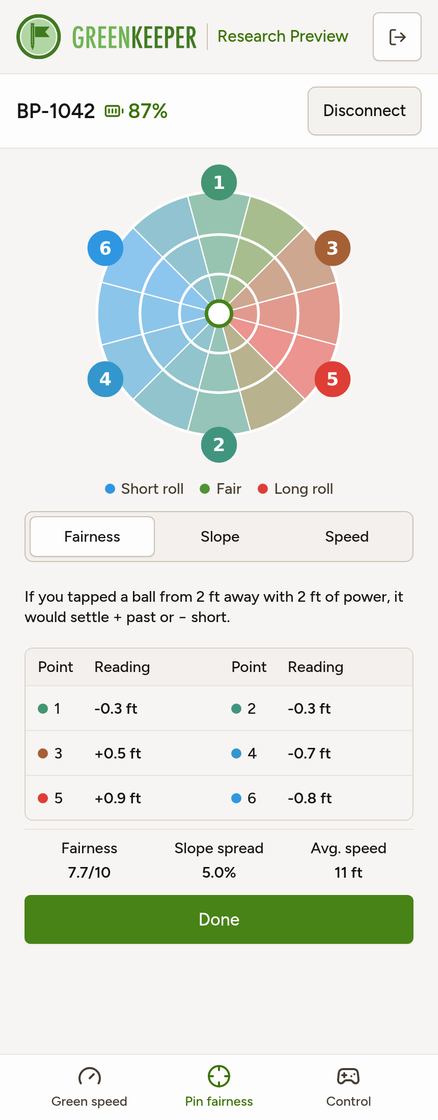
GreenKeeper Q’s Pin Fairness mode measures that relationship directly around a proposed hole location. Q travels in several directions around the area, measuring both local slope and ball roll characteristics, including green speed. GreenKeeper then uses those measurements to estimate how a ball would behave in each direction as it approaches—and misses—the hole.
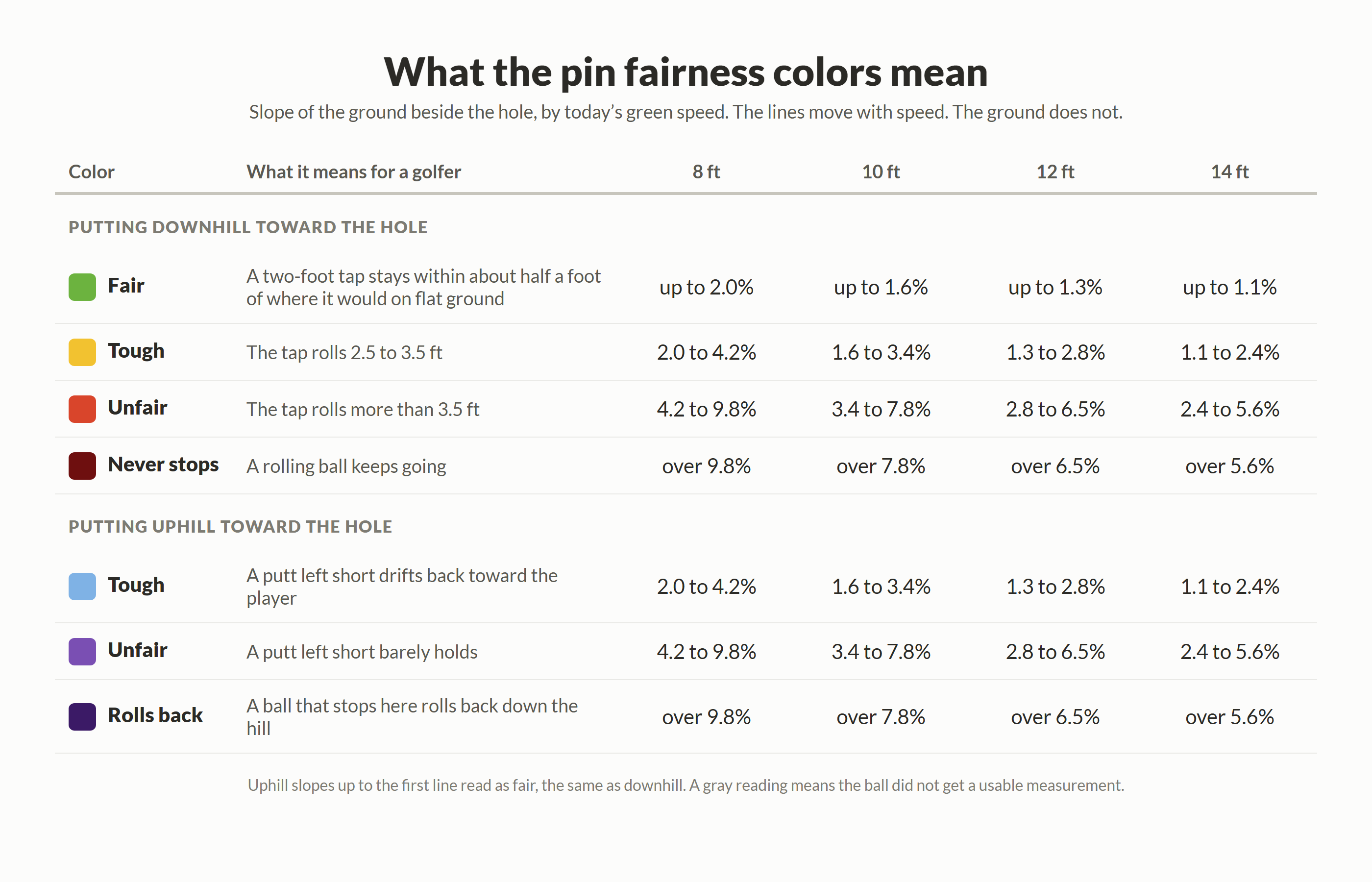
Figure 4. Pin Fairness classifications change with green speed. As the putting surface becomes faster, progressively less slope is required to move from fair to tough, unfair, and eventually a condition where a downhill ball will not stop.
This figure establishes the rules. The “Same Green. Four Green Speeds.” figure then demonstrates what those rules mean on an actual surface. The effect becomes much easier to understand when those thresholds are applied to an entire green. The contours of the green never change, but the amount of usable surface does.
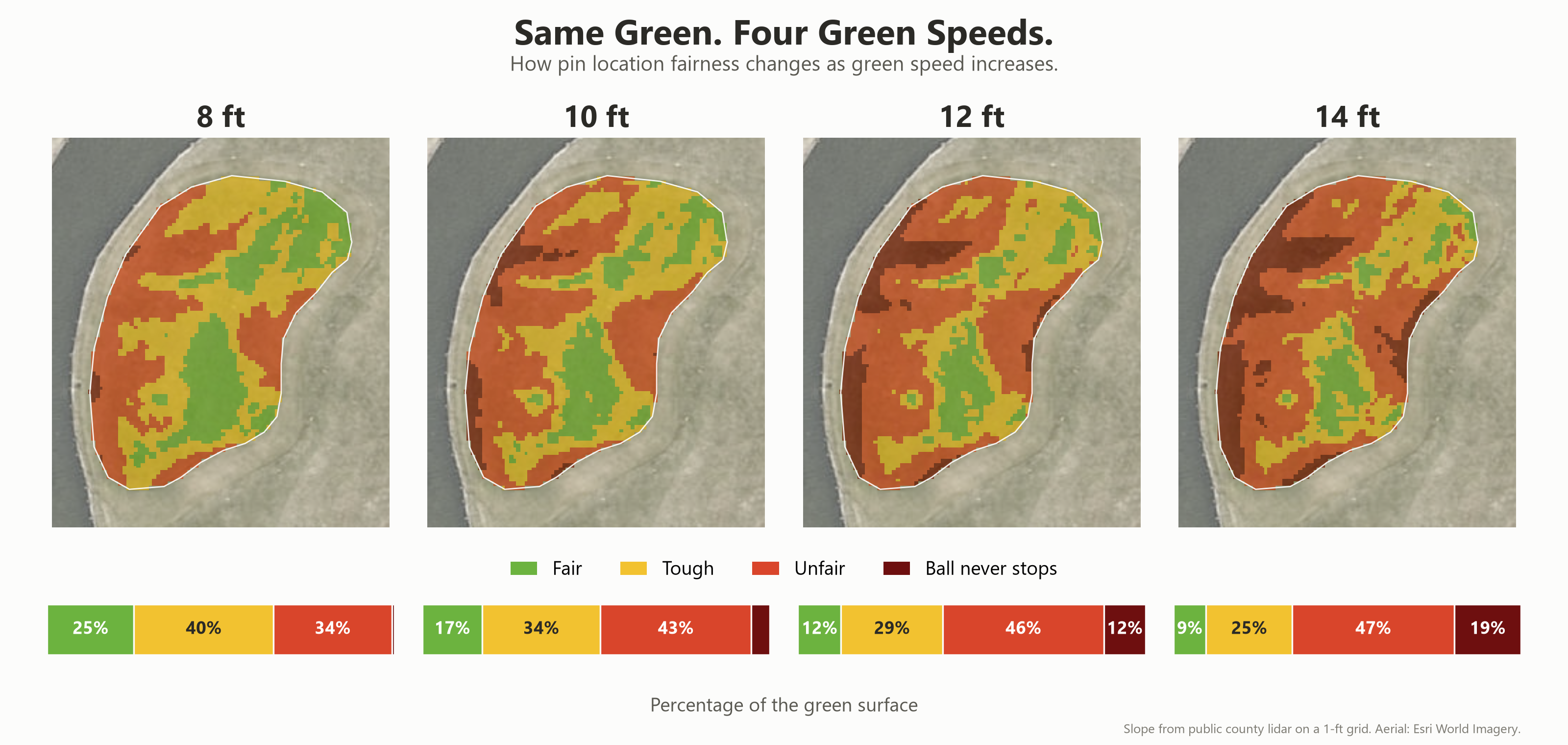
Figure 5. The same putting green evaluated at four different green speeds. As green speed increases from 8 to 14 feet, the percentage of the surface classified as fair decreases while the amount classified as unfair—or where a downhill ball would never stop—increases.
At 8 feet, about 25% of this green surface falls within the Fair range. At 14 feet, that falls to only 9%, while nearly two-thirds of the surface is classified as either unfair or steep enough that a downhill ball would continue rolling. Nothing about the architecture of the green changed. Only the green speed changed.
That is where Q becomes much more than another way to measure green speed. Pin Fairness combines speed, slope, and direction at the exact location where the cup is going to be cut. Too close to a false front or unfair slope? The operator gets immediate feedback from Q and can decide to move the cup in a different direction.
Q Plus GreenKeeper Data Aids Decision Making
Q is controlled through the upcoming GreenKeeper mobile app release for both iOS and Android. The phone connects directly to the robot, initiates the measurement, displays the results, and sends those data into GreenKeeper. This pairs greens performance data with other GreenKeeper measurements and—more importantly—with the agronomic data captured by GreenKeeper. Green speed measurements become more useful when they can be evaluated alongside mowing and rolling practices, cultivation, clipping volume and growth rate, PGR regulation, weather, and soil moisture data already being collected in GreenKeeper.
Q also includes a Remote Control mode where the operator steers the robot by tilting the phone while Q continues collecting motion data more than 60 times per second. Those measurements open the door to spatially mapping characteristics such as slope, roll quality, and surface resistance across larger areas of a green. We will explore those capabilities, along with the people and development work that brought Q from an idea to a commercial product, in future articles.
A New Way to Measure Putting Green Performance
GreenKeeper Q is not important because a robot can generate another green-speed number. We already know how to measure how far a golf ball rolls. The opportunity is to measure what is happening to the ball while it moves, separate some of the forces that have historically been combined into one stopping distance, and use those measurements to answer new questions about putting green performance. Pin Fairness is the first example, but it certainly will not be the last.